

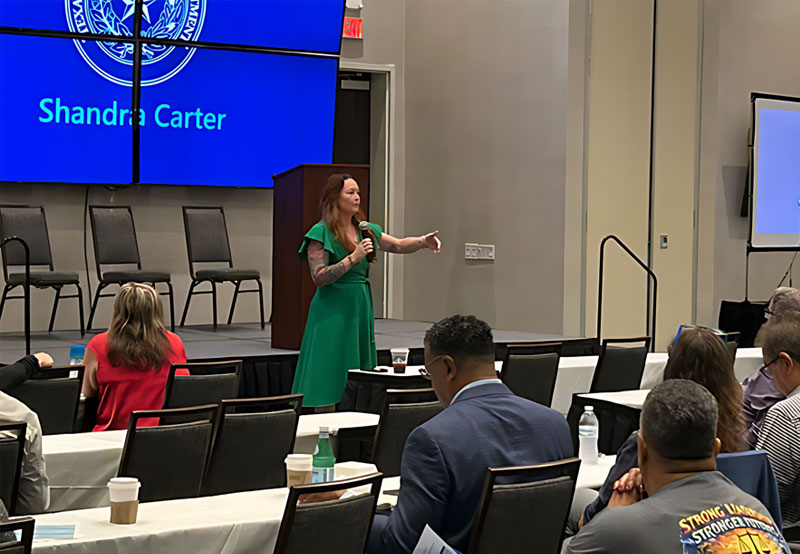
The Texas Juvenile Justice Department’s (TJJD) Probation Services Division partners with probation departments across Texas to strengthen services for youth referred to the juvenile justice system. We collaborate with juvenile boards, local probation departments, and TJJD divisions to coordinate efforts statewide.
TJJD supports juvenile probation chiefs through funding, training, and technical assistance to enhance local services and promote a “shallow-system” approach. The division also helps departments comply with state standards, provides specialized resources, and assists with the oversight, management, and funding of county-level juvenile probation departments and facilities. TJJD and Probation Services understand and recognize the wide diversity in the many departments across the state, though we all share the vital goal of helping young people reform and find success.
Online Resources for Chiefs
- Juvenile Justice Training Academy
- TJJD Regional Training Portal
- Credit for Webinar or E-Learning Course
- Correctional Management Institute of Texas (CMIT)
- Juvenile Justice Association of Texas (JJAT)
- Texas Probation Association (TPA) – Conferences
- Texas Institute on Children and Youth (TICY) | Concan TX | Facebook)
- SEMARC Use Guide
- SEMARC: Using the Search Engine (Training Video)
- Background Checks and More April 1, 2026 TAC Changes (Training Video)
- Regionalization Taskforce Team
- JPD Forms
- Noble Software Group
- Legislative Appropriations Request (2026-2027)
- Texas Department of Family and Protective Services (DFPS): Regional contact information
- Community Resource Coordination Groups
- Local Mental and Behavioral Health Authorities
- Texas Correctional Office on Offenders with Medical or Mental Impairments (TCOOMMI)
- Texas Administrative Code
- Texas Administrative Code Chapter 344 Rules, Frequently Asked Questions, July 2026
Stay Engaged
Governing Board
The 9-member governing board meets several times a year at locations across the state. The public is welcome to attend.
Advisory Council
The 13-member Advisory Council on Juvenile Services assists TJJD with long-range planning and review of operations.
Quarterly Newsletter
Subscribe to TJJD’s Quarterly Newsletter — CONNECTS — where we will keep you informed about all the work we’re doing in the juvenile justice system across the state of Texas.
Messages from TJJD
Sent: Tuesday, May 26, 2026 3:48 PM
Subject: Third quarter expenditures open next week
Good afternoon Chiefs and Fiscal Staff,
It has been a busy year, but we are more than half way through. Thank you all for your grace and diligence in helping us to close out fiscal year 24-25. We understand that this was a new time table and we appreciate all your work on this. First, some payment updates and then an important reminder below.
Payment updates:
State Aid, JJAEP, and RDA payment spreadsheets have been updated and are available on the TJJD website. The documents can now be found under the Continuum of Care tab — Documents.
If there are missing RDA reimbursements that you believe should have been paid, please check Fluxx to make sure you have selected "Submit for reimbursement". This is how your reimbursement requests show up on our end when we make payments, and we want to make sure you get paid!
This is a reminder that the 3rd Quarter (Q3) expenditure reporting window in FLUXX will open next Monday, June 1st.
Q3 Expenditure Entry Period:
June 1, 2026 – June 30, 2026
Please ensure all expenditures are entered accurately and submitted within the reporting window. Departments are expected to report expenditures for all applicable grants each quarter, including reports with zero expenditures.
Please review the following key policies and procedures:
- Adjustments may be made during the open reporting period as needed. But cannot be entered after you have submitted your expenditures. Only one of these options is available at a time.
- Once the quarter closes, corrections must be reflected in the following quarter.
- Reimbursements such as RDA and Detention Reimbursements reduce expenditures and should be credited back to the expenditure category from which the costs originated.
- Departments should verify that expenditures are entered under the appropriate budget categories and subcategories to ensure accurate legislative reporting.
- Please remember to save entries frequently in FLUXX before submitting reports.
Please also remember:
- Budget Adjustment Requests (BARs) are still required for cumulative changes, even under the updated policy allowing departments to internally track adjustments under 20% of the total State Aid budget.
- Special Requests are required for out-of-state travel and purchases over $10,000 using State Aid funds.
Attached you will find several tutorials. Should you think of anything else that you would like a tutorial on, please let us know. And as always, if you experience issues accessing FLUXX or have any questions regarding expenditure reporting, please reach out to me or Kristin Hammock.
Thank you for your continued excellence, you are all so appreciated.
Brandi Wagner
Probation Grants Manager
512-596-7982

Confidentiality Notice: The information contained in this email may be confidential and legally privileged. It is intended only for use of the individual named. If you are not the intended recipient, you are hereby notified that disclosing, copying, distributing, or taking any action in regard to the contents of this email except its direct delivery to the intended recipient is strictly prohibited. If you have received this message in error, please notify the sender immediately and delete it from your system.
From: Brandi Wagner
Subject: Third quarter expenditures open next week
Attachments: Supplemental Emergent Grants in Fluxx for Departments, New Chiefs Conference May 2026, How to request Access to Fluxx, How to enter the placement date in Fluxx, How to Enter an RE Discharge in Fluxx updated 5 2026, How to Detention Reimbursements, Budget Expenditure Categories Definitions, Expenditure Entry in Fluxx For Departments, How to PREA Audit Assistance, Budget Adjustment Requests for Departments in Fluxx 2025, Special Requests in Fluxx for Departments
Sent: Wednesday, May 20, 2026 3:13:33 PM
Subject: Announcement of Grant Opportunities - DSA Supplemental State Aid (Community and Residential Projects)
The Texas Juvenile Justice Department (TJJD) is pleased to announce a new DSA Supplemental State Aid Pre and Post Adjudication for residential projects and DSA Supplemental State Aid Community Programs for community projects. We are currently seeking applications, with priority given to projects supporting:
Priority Program Areas for Community Projects
Projects that address a regional priority outlined in the Continuum of Care Regional Reports (Section titled Priority Recommendations for the X Region ).
Priority Program Areas for Residential Projects
Projects supporting residential programs that:
- increase regional placement capacity to keep youth in placement closer to their home communities; and/or
- Serve female youth.
Grant Background
The Community and Residential Projects initiative fulfills the requirements of 223.001(c), Human Resources Code.
Community - The grant is for juvenile justice programs and services, including regional programs and services, that are provided in a non-residential setting and that are evidence-based and designed to that improve a juvenile probation department s ability to serve youth locally, improve outcomes, and decrease the likelihood of out of home placement or commitment to TJJD.
Residential - The grant is for juvenile justice programs or services that are either created or enhanced, provided in an out-of-home placement, evidence-based, and meant to improve a region s ability to serve youth locally, improve outcomes, and decrease the likelihood of commitment to
TJJD.
Time Line
May 21, 2026 Applications distributed to eligible departments
July 13, 2026 Applications are due to TJJD
August 17, 2026 Notices of award given to applicants
Contact Information
- Grant/Application Questions: Ashley Kintzer Ashley.Kintzer@tjjd.texas.gov
- Programmatic/Treatment Questions: Ally Matteson Allyson.Matteson@tjjd.texas.gov
- Data/Logic Model Support: Research Team Research@tjjd.texas.gov
Project Parameters
All terms and conditions of the State Financial Assistance Contract and General Grant Requirements documents apply.
Funding will be managed and tracked in the Grant Portal (FLUXX) under Discretionary State Aid: Pre and Post or Community.
Grant funds will be awarded to programs focused on identified target populations of need, with specific recidivism reduction goals, and utilizing research-based practices.
This is a one-time give of grant funds that can be used over the course of two years.
There must be a single grant application for each project. Similarly, reporting through the grant period will require a separate report for each project.
Performance Metrics
All performance measures can be found in the Summary Requirements in the State Aid Contract.
Grants will be awarded through a competitive application process, with no limit to the number of requests for funding that will be considered. Requests will be evaluated based on alignment with grant program requirements and identified strategic focus, potential juvenile justice system impact and funding availability.
Financial and data reporting will occur under Discretionary State Aid: Pre- and Post-Adjudication and Community, and TJJD will issue program naming conventions and data entry protocols within two weeks of awarding grant funds. Departments will be required to report program-defined output and grant-defined performance measures annually.
Funding will be subject to the same auditing requirements as all other state aid grant funds, as well as definitions of allowable and unallowable expenditures. Refunds will be due to TJJD if expenditures are determined to be unallowable under the terms of the State Aid and Financial Assistance and General Grant Requirements contract.
Application Components
Departments must submit application and logic model forms by the application due date to receive consideration.
Applicants must describe the target population for the proposed project and the manner in which the population was identified.
Applicants must describe the proposed residential project in detail, including:
o specific program interventions, curricula to be used, and intensity and frequency of services to be provided;
o how the proposed services are consistent with data-driven and research-based practice for the target population. Applicants may include attachments demonstrating that a proposed program or service is research-driven;
o the way in which a youth s risk and treatment needs will be identified, how program interventions address identified needs, and how the program will be responsive to individual youth strengths and needs,
o the expected level of licensure and/or training of the service providers, and
o organizational structure in place to support implementation of program approaches and interventions with fidelity.
Applicants must clearly describe how project success will be measured, including specific project-defined output and grant-defined outcome measures and how data to report on these measures will be collected, maintained, and reported.
Applicants must provide a cost analysis that gives the total project cost and an itemization of the cost categories included in the analysis.
Local financial or in-kind matching funds are not required, but may be considered in the review process alongside other requested information.
Application Submission
Applications may be submitted to TJJD electronically in the Grants Portal (FLUXX).
Applications received after July 13, 2026, will not be considered.
Ashley Kintzer
Texas Juvenile Justice Department
(512) 484-9094
Confidentiality Notice: The information contained in this email may be confidential and legally privileged. It is intended only for use of the individual named. If you are not the intended recipient, you are hereby notified that disclosing, copying, distributing, or taking any action in regard to the contents of this email except its direct delivery to the intended recipient is strictly prohibited. If you have received this message in error, please notify the sender immediately and delete it from your system.
From: Ashley Kinzer, Manager of Regionalization & Probation Support
Subject: Announcement of Grant Opportunities - DSA Supplemental State Aid (Community and Residential Projects)
Attachments: Protocol Announcement - DSA Supplemental, PCS-013a Grant Evaluation Panel Score Sheet
Sent: Wednesday, May 20, 2026 10:17 AM
Subject: Continuum of Care Update & New DSA Funding Opportunity
Chiefs,
Good morning. I want to provide an update on the Continuum of Care (CoC) work and outline next steps as we move forward.
Regional & Statewide CoC Reports – Updated Versions Available
The regional playbooks have been revised at the direction of the Department of Justice (DOJ) to ensure compliance with the “Improving Oversight of Federal Grantmaking Executive Order.” As part of this process, certain language and content areas were removed or adjusted at DOJ’s request, including commentary related to racial disparities, references to youth and families with lived experience, and culturally specific framing.
Last week, the Office of Juvenile Justice Delinquency and Prevention (OJJDP) provided additional guidance that they are no longer planning to approve our reports as part of the process, the only requirement is that we submit them. This guidance will allow us to release the reports broadly without additional delays with the approval process; however, as the reports have not been approved by OJJDP we will be removing their name from the reports. We also received guidance that TJJD is not allowed to publicize the reports until our grant end at the end of June 2026, at which point we can choose how we would like to publicize.
You can still access the reports at the link sent previously: Continuum of Care (COC) - MMHPI - Meadows Mental Health Policy Institute
The Statewide Continuum of Care report and the updated regional playbooks (with OJJDP removed) will be available on the link by the end of next week – May 29, 2026. THANK YOU FOR YOUR PATIENCE WITH THIS PROCESS! We are excited that we now have a path forward to disseminate the reports.
In summary:
- Each regional playbook now includes a visual 2-page executive summary for easier sharing and use.
- The revised regional playbooks and the statewide report will be saved in the shared folder on the link next week.
- These versions may now be used and shared locally; however, they are not yet approved for public posting and should not be posted to external websites at this time.
New Supplemental Discretionary State Aid Funding – Request for Proposals (RFP)
Later this afternoon, Ashley Kintzer will be sending an email releasing the RFP applications for this new funding opportunity. These funds (approximately $3M statewide) are a result of refunds to TJJD and therefore are only available for spend over the course of two years, not our standard six-year cycle. JPDs may submit applications for residential and/or community projects with the following priorities:
Priority Program Areas for Community Projects
Projects that address a regional priority outlined in the Continuum of Care Regional Playbooks (Section titled “Priority Recommendations for the X Region”).
Priority Program Areas for Residential Projects
Projects supporting residential programs that:
- increase regional placement capacity to keep youth in placement closer to their home communities; and/or
- Serve female youth.
Ashley’s email later this afternoon will contain additional detail.
Your TJJD Regional Continuum of Care Coordinator (see attached CoC Coordinator contact list) is available to support you with your applications, especially related to the community project priority as it is tied to the Continuum of Care priorities in the Regional Playbooks.
Transition to Implementation Phase
With the completion of the planning and assessment phase of our OJJDP Continuum of Care grant, we are now formally transitioning into implementation.
What this means for you:
- TJJD regional CoC coordinators will begin working directly with you to prioritize findings from your regional playbooks and translate them into actionable steps.
- You can expect outreach from your regional coordinator to begin planning next steps and advancing regional findings and recommendations into action.
- The Meadows Mental Health Policy Institute (Meadows) team will remain under contract through the end of the summer to support implementation efforts, including tools, facilitation, and technical assistance. NOTE: TJJD has also applied for 2 separate federal grant opportunities through OJJDP to support long-term implementation (we expect to hear back soon on one of them we submitted in October 2025), and we are finalizing a 3rd grant application this month. TJJD and Meadows are committed to supporting implementation efforts in partnership with JPDs and regions to move the priorities identified in the playbooks forward.
Statewide Systems Work Underway
At the same time, we are continuing to advance system-level strategies in partnership with key agencies, including HHSC and DFPS. This work includes:
- Development of high-complexity youth solutions (crisis residential, long-term secure residential under HHSC, and evidence-based intensive in-home service models like MST and FFT)
- Coordination of a joint legislative strategy (TJJD/HHSC/DFPS/Meadows), including Legislative Appropriations Request priorities and exceptional items
- Alignment with Sunset review of Regionalization
- Continued advancement of TJJD’s regionalization strategy
We appreciate your continued partnership and leadership in this work. Please reach out to your regional coordinator or to our team if you have any questions.
Thank you,
-Matt
Matt Smith, LPC-S
Director of Statewide Youth Services Continuum
Texas Juvenile Justice Department
TJJD Mobile: 737-406-5656
Confidentiality Notice: The information contained in this e-mail may be confidential and legally privileged. It is intended only for use of the individual named. If you are not the intended recipient, you are hereby notified that the disclosure, copying, distribution, or taking of any action in regards to the contents of this e-mail except its direct delivery to the intended recipient is strictly prohibited. If you have received this message in error, please notify the sender immediately and delete it from your system
From: Matt Smith, Director of Statewide Youth Services Continuum
Subject: Continuum of Care Update & New DSA Funding Opportunity
Attachments: TJJD Regional Teams - Coordinators 4
Sent: Tuesday, May 12, 2026 8:44 AM
Subject: CSE-IT training and TNOYS Conference
We would like to invite you to TNOYS' upcoming FREE virtual training on the Commercial Sexual Exploitation-Identification Tool (CSE-IT), Wednesday, May 20, from 9:00 a.m. to 12:30 p.m. The CSE-IT is a research-based screening tool that helps improve early identification of commercially sexually exploited youth (CSEY).
We know that juvenile justice professionals make up the majority of all screenings conducted using the CSE-IT in Texas, and probation is now required to assess youth with the CSE-IT before disposition, and we would love for TNOYS' virtual CSE-IT training to continue strengthening the work of the field to identify and support young people impacted by, or at risk of, CSEY.
To join the free training, please register at this link [tfaforms.com]. Registration includes a quick 2-minute pre-survey that TNOYS conducts in partnership with The Office of the Governor's Child Sex Trafficking Team. Participants who complete the full training will be CSE-IT certified and earn 3.5 continuing education credit hours.
If you have any questions about the training, please don't hesitate to reach out to our Practice Team at practice@tnoys.org.
Additionally, for digging even deeper into the efforts to prevent, identify, and address CSEY, our upcoming Annual Conference on Services for Youth and Families has an expanded track of workshops dedicated to research, coordination, and best practices for youth-serving professionals working with young people who may be impacted by sexual exploitation. To see the list of Preventing & Addressing CSEY workshops at this year's conference, check out our Whova digital program preview here [whova.com], and learn more about registering for the conference on our webpage [tnoys.org].
Best,
Lauren Rose (she/her)
Director of Public Policy
Texas Network of Youth Services
512-775-7745
|www.tnoys.org [tnoys.org]
From: Ashley Kinzer, Manager of Regionalization & Probation Support
Subject: CSE-IT training and TNOYS Conference
Sent: Wednesday, May 6, 2026 1:00 PM
Subject: TJJD Field Update - Appreciation Weeks, Senate CJ, & Q2 Board Meeting
Happy Wednesday Chiefs,
As we enter Mental Health Awareness Month alongside Correctional Officer, Nurse, and Teacher Appreciation Weeks, I want to take a moment to recognize the work that's being done every day across Texas’ juvenile justice system! The work is not easy. Each day, you serve our communities by supporting the safety and rehabilitation of the youth in our care. You show up with consistency and professionalism in environments that are challenging, and your presence helps create stability and support where it’s needed most. Thank you to all you and your staff do to keep communities safe and rehabilitate youth!
I wanted to share a couple of quick updates with you.
First, the Senate Criminal Justice Committee held its first interim hearing related to the juvenile charge yesterday. You can watch the video by following this link. I’ve also attached the PPT we gave to all the members and you can find it on our Chiefs Toolkit page on our website by clicking this link. I’d like to thank Chiefs Worley and Carter for testifying during the hearing and TJJD Board member, Chief Edeska Barnes, for attending and showing support. Executive Director Shandra Carter, Deputy Executive Director Sean Grove, and Deputy General Counsel Kaci Sohrt represented TJJD on the first panel. The second panel also included TJJD Board Member, Judge Cyndi Wheless. Overall, it was a good hearing where agency officials and chiefs were able to express needs to improve the system. We are currently collaborating with legislative leaders in both chambers, and if there are any members you think we should engage – just let me know and we will connect! Also, just a reminder, our Q2 board meeting is Friday, May 15th at 9 am. If you’d like attend in person, or watch online, please visit our website for more information. If you have any questions or need anything from me, please let me know. Thank you! Best, Nathan C. McDaniel Chief of Staff Texas Juvenile Justice Department
1801 N. Congress, Austin, TX 78701 nathan.mcdaniel@tjjd.texas.gov 737-393-7959 (c) | 512-490-7130 (o) Transforming young lives and creating safer communities. Confidentiality Notice: The information contained in this e-mail may be confidential
and legally privileged. It is intended only for use of the individual named. If you are not the intended recipient, you are hereby notified that the disclosure, copying, distribution, or taking of any action in regards to the contents of this e-mail
except its direct delivery to the intended recipient is strictly prohibited. If you have received this message in error, please notify the sender immediately and delete it from your system
Nathan
From: Nathan McDaniel, Chief of Staff
Subject: TJJD Field Update - Appreciation Weeks, Senate CJ, & Q2 Board Meeting
Attachment: Supplemental Slides for May 5, 2026
Sent: Thursday, April 2, 2026 4:14:30 PM
Subject: Interim Charges & More
Hi Chiefs,
I hope y all are doing well! I apologize I haven t been sending emails to the field as frequently as I used to, it has been very busy over here. But, I m happy to announce we are interviewing applicants for the stakeholder relations role I was in before becoming
Chief of Staff so there will be more regular updates soon!
Interim Charges and LBB Data
I ve also attached the full list of Senate and House interim charges that were recently released. The charges directly related to juvenile justice are below:
Senate Addressing Juvenile Violence: Study the growing violence among juveniles both in communities and state and county secure facilities. Examine the effectiveness of juvenile diversion programs, sentencing laws, and whether determinate sentences for all 3G violent juvenile offenders would better ensure public safety. Make recommendations to improve juvenile outcomes and protect the public.
House Juvenile Justice: Evaluate the effectiveness of indeterminate and determinate sentencing in promoting accountability, rehabilitation, and public safety, including whether current commitment and probation practices for serious offenses provide sufficient supervision. Recommend any statutory or policy changes to improve coordination, strengthen accountability, identify barriers in information sharing, and enhance public safety.
This is not set in stone yet, but we are hearing that the Senate will be holding their interim charge hearings in the first part of May. We will update when there is a solidified date.
Additionally, the LBB recently published updated juvenile justice data from TJJD and across the state.
If you have any questions or if I can be a resource in any way, please do not hesitate to reach out. I look forward to seeing many of you at JJAT in Lubbock later this month!
Best,
Nathan
Nathan C. McDaniel
Chief of Staff
Texas Juvenile Justice Department
1801 N. Congress, Austin, TX 78701
nathan.mcdaniel@tjjd.texas.gov
737-393-7959 (c) | 512-490-7130 (o)
Transforming young lives and creating safer communities.
Confidentiality Notice: The information contained in this e-mail may be confidential and legally privileged. It is intended only for use of the individual named. If you are not the intended recipient, you are hereby notified that the disclosure, copying, distribution, or taking of any action in regards to the contents of this e-mail except its direct delivery to the intended recipient is strictly prohibited. If you have received this message in error, please notify the sender immediately and delete it from your system
From: Nathan McDaniel, Chief of Staff
Subject: Interim Charges & More
Attachments: 2026 Interim Charges; House Interim Charges 3/25